Why Do Old Eggs Float in Water?
VERIFIED ANSWER
Have you ever wondered why old eggs float in water while fresh eggs usually sink? This is a simple but fascinating science fact that you can easily test at home. A fresh egg contains a small air pocket between its inner membranes. The eggshell is covered with tiny pores that allow gases and moisture to […]
Have you ever wondered why old eggs float in water while fresh eggs usually sink? This is a simple but fascinating science fact that you can easily test at home.
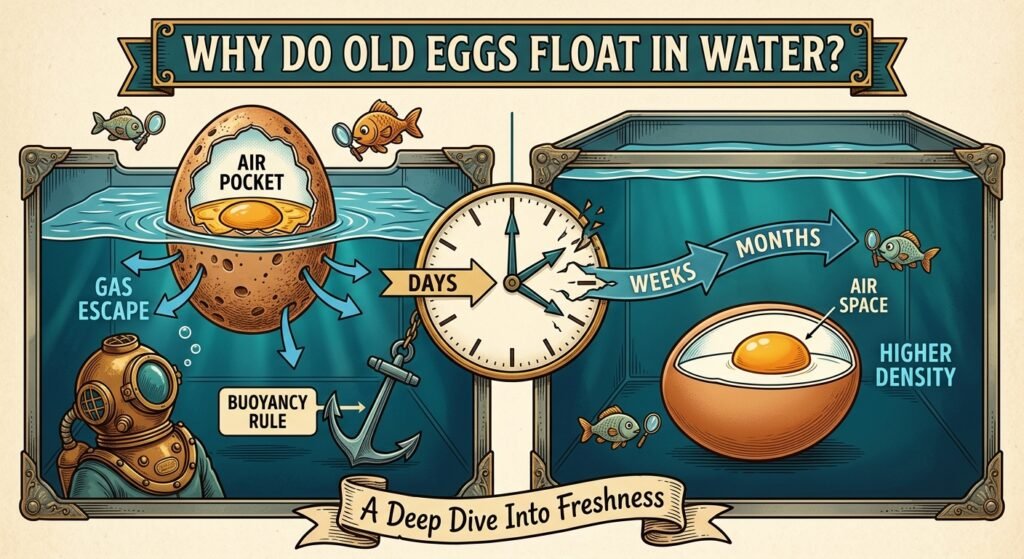
A fresh egg contains a small air pocket between its inner membranes. The eggshell is covered with tiny pores that allow gases and moisture to pass through. As an egg gets older, some of the water inside it slowly evaporates through these pores, while air gradually enters and enlarges the air pocket.
Because of this growing air pocket, an old egg becomes less dense than water. When its overall density becomes lower than the density of water, the egg rises and floats. A fresh egg, on the other hand, is denser than water, so it normally sinks to the bottom.
What Does the Floating Test Mean?
You can place an egg gently into a glass of water:
- Fresh egg: Usually sinks and lies flat.
- Older egg: May stand upright or tilt upward.
- Very old egg: May float completely.
The Answer
Old eggs float because their internal air pocket becomes larger over time, making the egg less dense and more buoyant in water.
However, floating does not automatically mean that an egg is unsafe to eat. It mainly indicates that the egg is older. Before using an older egg, crack it into a separate bowl and check for any unusual smell, appearance, or texture. When in doubt, it is better to throw it away.
This interesting question is also featured on our YouTube channel Realityfacts4u, where we share fascinating facts and surprising answers to everyday questions.
So, the next time an egg floats in water, you’ll know the science behind it—the growing air pocket inside the egg is the reason!