Why Can’t You Die in Longyearbyen, Norway? The Real Reason
VERIFIED ANSWER
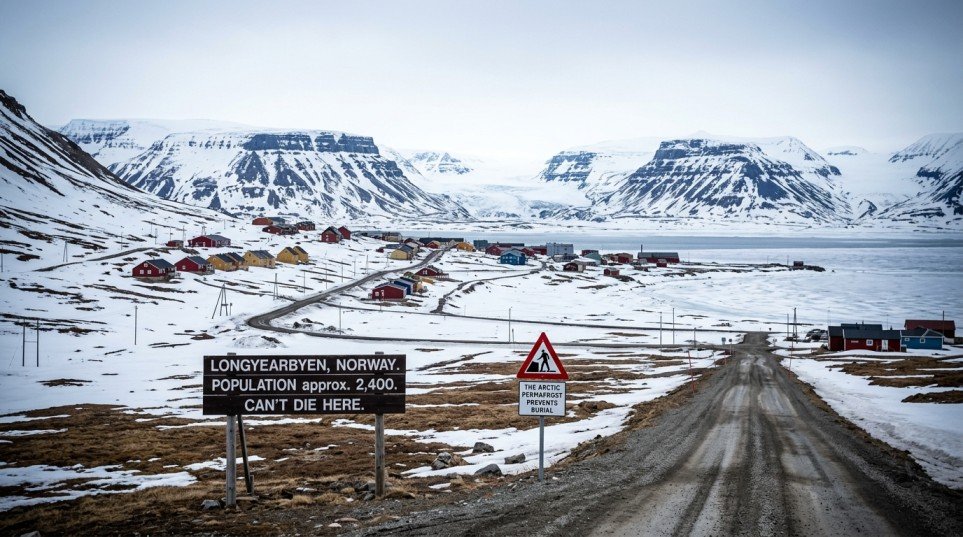
Why can’t you die in Longyearbyen? The short answer: the ground is frozen solid all year, so bodies buried there do not decompose. Since 1950, the small Arctic town of Longyearbyen in Svalbard, Norway, has not allowed new coffin burials. Anyone who is seriously ill or near the end of life is moved to mainland […]
Why can’t you die in Longyearbyen?
The short answer: the ground is frozen solid all year, so bodies buried there do not decompose. Since 1950, the small Arctic town of Longyearbyen in Svalbard, Norway, has not allowed new coffin burials. Anyone who is seriously ill or near the end of life is moved to mainland Norway. That is why the world calls it the “town where it is illegal to die,” even though no one has ever been arrested for dying.
In this article, we separate the myth from the facts. You will learn what the rule really says, how permafrost changed the town’s history, what scientists found in old graves, and why babies are not born there either.
Where Is Longyearbyen?
Longyearbyen is the largest settlement in Svalbard, a group of Arctic islands between mainland Norway and the North Pole. It sits roughly 1,300 km from the Pole and is home to around 2,000 to 2,500 people. The town was founded in 1906 by an American businessman, John Munro Longyear, as a coal-mining camp. Today, people there work in research, tourism, and local services.
Life there is extreme. The sun does not rise for about four months in winter, and in summer it never sets. Polar bears roam outside the town, so people must carry protection when they leave the settlement. These harsh conditions are also the reason behind its famous death rule.
Is It Really Illegal to Die in Longyearbyen?
Not exactly. There is no law that punishes a person for dying. The real rule is about burial, not death itself. Since 1950, the local cemetery has stopped accepting new coffin burials. On top of that, the town has no nursing homes or long-term care for elderly people.
So in practice, when someone becomes terminally ill or too frail to live alone, they are flown to the mainland, usually to the hospital in Tromsø. If someone dies suddenly in Longyearbyen, their body is sent south for the funeral and burial. This is why people say you can’t die in Longyearbyen Norway, but a more accurate phrase would be “you can’t be buried there.”
Why Can’t You Be Buried in Svalbard? The Permafrost Problem
The main answer to why you can’t be buried in Svalbard is a frozen layer of earth called permafrost. Permafrost is ground that stays at or below 0°C for at least two years in a row. In Svalbard, it can go down many meters deep.
Only the top layer, called the “active layer,” thaws a little in summer. Everything below it stays frozen. Here is what this means for a grave:
- No decomposition: Bacteria that break down bodies cannot work in frozen soil. That is why bodies don’t decompose in permafrost. They stay preserved for decades.
- Frost heave: When the top layer freezes and thaws again and again, the ground moves. Over time, this movement can push buried objects, including coffins, toward the surface.
- Health risk: If a body does not break down, the germs inside it may not break down quickly either. Town leaders did not want old diseases to become a risk to the living.
In 1950, locals saw that bodies in the old graveyard were not decaying at all. That discovery is what ended traditional burials in the town.
The 1918 Spanish Flu Link: What Scientists Actually Found
The most famous part of this story involves the Spanish flu victims buried in Svalbard. In 1918, the deadly flu pandemic reached Longyearbyen. Seven young coal miners died and were buried in the town’s small cemetery.
In 1998, a team of scientists carefully dug up these graves. They wanted to learn why the 1918 flu was so deadly, since it killed tens of millions of people worldwide. The frozen ground had kept the tissue in good condition for 80 years.
Many websites claim the virus was found “alive.” That is not quite right. The researchers recovered genetic material (fragments of the virus’s RNA), not a working, infectious virus. Still, the find showed how well permafrost preserves everything inside it, and it helped scientists study the virus. This story is a big reason the burial ban is so well known today.
What Happens If Someone Dies in Longyearbyen?
Deaths still happen, for example from accidents or sudden illness. When they do, this is the usual process:
- The body is flown to mainland Norway.
- The family arranges a funeral and burial there.
- Families who want a link to Svalbard can choose cremation. With special permission from the authorities, an urn of ashes may be buried in Longyearbyen.
Because of the rule, Longyearbyen is a place where most people come to work and live for a few years, not to spend their whole lives. People are expected to support themselves, and the town is built for a healthy, active population.
Can You Be Born in Longyearbyen?
Here is a fact many people don’t know: you usually can’t be born in Longyearbyen either. The town has a small hospital, but it is not set up for births. Expectant mothers normally travel to the mainland about three weeks before their due date and give birth there, often in Tromsø.
This is why some writers call Svalbard the place where you can neither be born nor die. Both rules come from the same reason: the town is remote, and its medical services are limited.
Other Strange Rules in Longyearbyen
The burial ban is not the only unusual rule in this Arctic town:
- No cats: Cats are not allowed in Svalbard, to protect the local bird life.
- Alcohol limits: Residents have a monthly limit on how much alcohol they can buy.
- Rifles outside town: Because of polar bears, people must carry protection when they go beyond the town limits.
- Open doors: Many people leave homes and cars unlocked, so anyone fleeing a polar bear can find shelter.
- Shoes off: It is a local custom to remove your shoes when entering homes and many public buildings, a habit from the coal-mining days.
Is Longyearbyen the Only Town Where It Is Illegal to Die?
No. Longyearbyen is the most famous town where it is illegal to die, but it is not alone. In ancient Greece, dying on the sacred island of Delos was not allowed. In Japan, the holy island of Itsukushima has kept traditions against births and deaths on the island for centuries. A few other towns around the world have also “banned” death, mostly as a joke or a protest about full cemeteries. Longyearbyen is different because its rule exists for a real scientific reason.
Quick Facts Table
| Fact | Details |
|---|---|
| Location | Svalbard, Norway (Arctic) |
| Burial ban started | 1950 |
| Main reason | Permafrost stops bodies from decomposing |
| Famous discovery | 1918 flu genetic material recovered in 1998 |
| Where sick people go | Mainland Norway (usually Tromsø) |
| Births | Usually on the mainland |
Frequently Asked Questions
Why is it illegal to die in Longyearbyen?
It is not truly illegal to die. Since 1950, new coffin burials have not been allowed because permafrost keeps bodies from decomposing. Seriously ill people are moved to the mainland instead.
Can you die in Longyearbyen Norway?
Yes, a person can die there, for example in an accident. But the body is sent to mainland Norway for burial. Nobody is punished for dying.
Why don’t bodies decompose in Svalbard?
The ground is permanently frozen. The bacteria that break down a body cannot work at such low temperatures, so remains stay preserved for decades.
Was the Spanish flu virus found alive in Longyearbyen?
No. Scientists recovered fragments of the virus’s genetic material from the 1918 victims in 1998, not a live virus that could infect people.
Can you be buried in Longyearbyen at all?
Coffin burials are not allowed. Cremated ashes in an urn may be buried with special permission from the authorities.
Final Thoughts
So, why can’t you die in Longyearbyen? Because the frozen Arctic ground will not let the dead rest the normal way. Bodies stay preserved, graves can shift, and old diseases could be locked inside. Instead of risking the health of the living, this tiny town chose a simple solution: care for the dying and the dead on the mainland. It is one of the strangest, and most sensible, rules in the world.