Pheasant Island: The Island That Changes Country Every 6 Months
VERIFIED ANSWER
Imagine going to sleep in Spain and waking up in France without moving an inch. It sounds like a riddle, but there is a real place where this happens every year. It is a tiny piece of land called Pheasant Island, and it is the only island that changes country every six months. No one […]
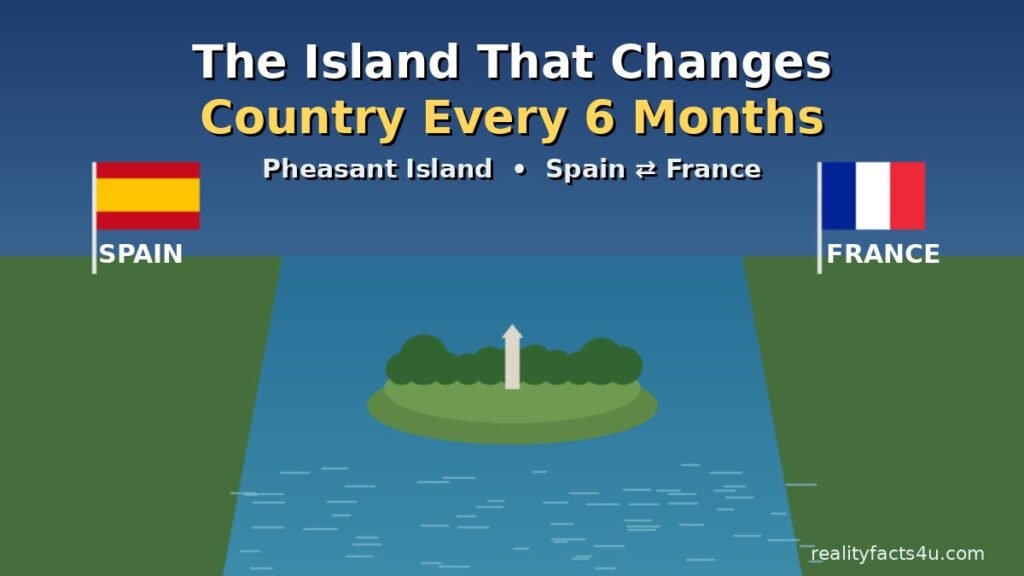
Imagine going to sleep in Spain and waking up in France without moving an inch. It sounds like a riddle, but there is a real place where this happens every year. It is a tiny piece of land called Pheasant Island, and it is the only island that changes country every six months.
No one lives there, no shops or houses stand on it, and most people are not allowed to step on it. Yet this small patch of grass has a story that involves kings, a long war, a royal marriage and one of the oldest peace deals in Europe. Let’s find out how this strange arrangement works and why it still exists today.
Where Is Pheasant Island?
Pheasant Island sits in the middle of the Bidasoa River, the river that forms part of the border between Spain and France. It lies close to where the river meets the Bay of Biscay, in the Basque Country region.
On one bank of the river is the Spanish town of Irun. On the other bank is the French town of Hendaye. The island sits between them, so close to both towns that you can see it clearly from either side.
The island is known by several names:
- Pheasant Island: its English name
- Isla de los Faisanes: its Spanish name
- Île des Faisans: its French name
- Conference Island: a historical name, because of the peace talks held there
How big is it? Different sources give slightly different numbers. Most say it is about 200 metres long and around 40 metres wide, which is roughly the size of two cricket grounds placed side by side. River water has slowly eaten away its banks over the centuries, and the island is believed to be much smaller today than it was in the 1600s.
Why Does Pheasant Island Change Countries?
Most border islands are simply split down the middle, with each country owning one half. Pheasant Island is different. Instead of dividing the land, Spain and France agreed to take turns controlling the whole island.
In legal terms, a territory controlled by more than one country is called a condominium. Pheasant Island is often described as the oldest condominium in the world, and it is the only one where control switches back and forth on a fixed timetable instead of being shared at the same time.
Here is how the yearly schedule works:
| Period | Country in Control | Duration |
|---|---|---|
| 1 February – 31 July | Spain 🇪🇸 | 6 months |
| 1 August – 31 January | France 🇫🇷 | 6 months |
So when people ask why the island changes nationality every 6 months, the simple answer is this: it is a symbol of peace, and neither country wanted to own it alone.
The History: A War, a Treaty and a Royal Wedding
A long and costly war
In the 1600s, France and Spain were two of the most powerful kingdoms in Europe, and they were bitter rivals. From 1635 to 1659 they fought a war that lasted 24 years. Both sides lost huge amounts of money and thousands of lives. By the end, both kings were tired and wanted peace.
Why the island was chosen
Peace talks had a big problem. Neither side trusted the other enough to travel into enemy land. The solution was Pheasant Island. It belonged to neither kingdom in a clear way, and it sat right on the border. Both delegations could reach it without stepping into the other country.
Over several months, the chief ministers of France and Spain met on the island again and again. These meetings are the reason it earned the name “Conference Island.”
The Treaty of the Pyrenees (1659)
In November 1659, the two kingdoms signed the Treaty of the Pyrenees on the island. The treaty ended the war, moved the border between the two countries, and gave some Spanish land to France. A stone monument still stands on the island today to mark this event.
A marriage to seal the peace
To make the peace stronger, the treaty also arranged a royal marriage. King Louis XIV of France would marry Maria Theresa of Spain, the daughter of the Spanish king Philip IV.
In 1660, Pheasant Island was used once again. The two royal families met there, and the Spanish princess was handed over to the French side. The wedding itself did not happen on the island. It took place shortly afterwards in the French town of Saint-Jean-de-Luz. Some websites say the couple married on the island, but that is a common mistake.
Because the island had hosted the peace talks, the treaty and the royal meeting, both nations treated it as a shared symbol. Over time, this was turned into the six-month rotation that continues to this day.
Who Owns Pheasant Island Now?
The answer depends on the date. If you are reading this between 1 February and 31 July, the island is under Spanish control. From 1 August to 31 January, it is under French control.
In practice, the island is looked after by the naval authorities of each country during their six months. Workers from the town councils of Irun and Hendaye visit to cut the grass, trim the trees and keep the monument clean.
What Happens on Handover Day?
You might picture soldiers, flags and a big ceremony. The reality is much quieter. On handover day, officials from both countries meet and complete a simple official transfer of responsibility. There is no army, no crowd and usually no flag-raising. One day the island is managed by Spain, and the next day France takes over, just like a change of shift.
Why Is It Called Pheasant Island?
Here is a fun twist: there are no pheasants on Pheasant Island. The famous French writer Victor Hugo visited in 1843 and was disappointed to find none.
No one knows for certain where the name came from. A popular explanation is that it grew out of an older local name that was misheard or mistranslated over the centuries, until it ended up sounding like the word for “pheasant.” Whatever the true origin, the name stuck, birds or no birds.
Can You Visit Pheasant Island?
For most of the year, no. The island is closed to the public, and there is no bridge or boat service to reach it. Only officials and maintenance workers are normally allowed to land there. On rare occasions, local tourism offices organise special guided visits, but these are limited and not held regularly.
The good news is that you can see the island very clearly from the riverbanks:
- From Spain: walk along the riverside promenade in Irun, which runs right in front of the island.
- From France: view it from the riverbank in Hendaye, on the opposite side.
- Nearest airports: San Sebastián Airport in Spain and Biarritz Airport in France are both a short drive away.
Other Strange Shared Territories Around the World
Pheasant Island is unique, but it is not the only unusual border arrangement in the world:
- The Moselle River: parts of this river are jointly controlled by Germany and Luxembourg as a shared territory.
- Lake Constance: Germany, Austria and Switzerland surround this lake, and they have never fully agreed on where the borders inside it are.
- Andorra: this small country between Spain and France has two heads of state at the same time, the President of France and a Spanish bishop.
Still, none of these places switch owners on a calendar. That is what makes Pheasant Island truly one of a kind.
Frequently Asked Questions
Which island changes country every six months?
Pheasant Island, located in the Bidasoa River between Spain and France, changes control every six months. Spain controls it from 1 February to 31 July, and France from 1 August to 31 January.
Why does Pheasant Island switch countries between France and Spain?
It became a shared symbol of peace after the Treaty of the Pyrenees was signed there in 1659. Instead of dividing it, both countries agreed to take turns controlling it.
Does anyone live on Pheasant Island?
No. The island is uninhabited and has no houses or buildings, only trees, grass and a stone monument to the 1659 treaty.
Are there pheasants on Pheasant Island?
No. Despite its name, there are no pheasants on the island. The origin of the name is uncertain.
Can tourists visit Pheasant Island?
Not normally. The island is closed to the public, but you can see it from the riverbanks in Irun (Spain) and Hendaye (France). Rare guided visits are sometimes organised.
Is Pheasant Island the oldest condominium in the world?
It is often described as the oldest surviving condominium, and it is the only one where control rotates between two countries on a fixed schedule.
Conclusion
Pheasant Island may be small, empty and closed to visitors, but its story is huge. A piece of land that once hosted kings, ministers and a royal handover now quietly changes hands twice a year, all because two old enemies chose peace over war more than 350 years ago. The next time someone tells you borders never change, you can tell them about the little island that changes country every six months.