At its peak around 1279, the Mongol Empire covered about 24 million square kilometers (9.3 million square miles) — roughly 16% of Earth’s land. It ruled an estimated 110 million people, about a quarter of the world’s population at the time, making it the largest connected (contiguous) land empire in history.
In 1206, the Mongols were a scattered group of nomadic tribes on the cold grasslands of Central Asia, with no cities, no navy and a population smaller than many modern countries. Just 73 years later, their empire stretched from the Sea of Japan to the edge of Central Europe. No other land empire — before or since — has grown so big, so fast. So how big was the Mongol Empire really, and how could anyone control so much land on horseback?
In this article
- How Big Was the Mongol Empire in Numbers?
- How Does It Compare to Other Empires?
- Which Modern Countries Were Part of It?
- How Did the Mongols Conquer So Much So Fast?
- How Did They Control Such a Huge Empire?
- Why Did the Mongol Empire Break Apart?
- What Did the Mongol Empire Leave Behind?
- Frequently Asked Questions
- The Mongol Empire in 8 Key Facts
If you have ever asked how big was the Mongol Empire, the short answer is “bigger than any empire you can walk across.” In this guide we break down the real size of the Mongol Empire with numbers you can picture, compare it with the Roman, Russian and British empires, explain how the Mongols ruled such a vast area, and show why it all split apart in less than a century.
How Big Was the Mongol Empire in Numbers?
According to Guinness World Records, the Mongol Empire at its height around 1279 under Kublai Khan covered about 24 million km² and ruled over 110 million people. Here are the key numbers:
- Land area: about 24 million km² (9.3 million square miles).
- Share of Earth’s land: roughly 16% — about one-sixth of all the land on the planet.
- Population: around 110 million people, about one in four humans alive at the time.
- Founded: 1206, when Temüjin was proclaimed Genghis Khan.
- Peak size: around 1279, under his grandson Kublai Khan.
- End of the main dynasty: 1368, when the Mongol-led Yuan dynasty fell in China.
To picture it: 24 million km² is about 80% of the size of Africa, almost 2.5 times the size of the United States, and more than 25 times the size of Pakistan. A rider crossing it from east to west would travel thousands of kilometers through deserts, mountains, forests and grasslands without ever leaving Mongol territory.
The Mongol Empire was not just big. It was one single connected block of land — and that is what makes it unique.
How Does It Compare to Other Empires?
You may have heard that the British Empire was bigger — and that is true. But there is an important difference.
| Empire | Peak year | Area | Connected? |
|---|---|---|---|
| British Empire | 1920 | ~35.5 million km² | No — spread across oceans |
| Mongol Empire | 1279 | ~24 million km² | Yes — largest ever |
| Russian Empire | c. 1895 | ~22.8 million km² | Yes — second largest |
| Roman Empire | 117 AD | ~5 million km² | Yes |
What does “contiguous” mean? A contiguous empire is one connected piece of land — you could ride from one end to the other without crossing a sea or foreign country. The British Empire was larger overall, but its colonies were scattered across the globe and linked by ships. The Mongol Empire was one unbroken landmass, which is why it holds the record for the largest contiguous empire in history.
The comparison with Rome is the most surprising. The Roman Empire took centuries to grow, yet at its peak it was only about one-fifth the size of the Mongol Empire. Historians often say the Mongols conquered more land in about 25 years than Rome did in 400.
Which Modern Countries Were Part of It?
At its height, Mongol rule or control reached all or part of the land of dozens of modern countries, including:
- East Asia: Mongolia, China, Korea (as a vassal state)
- Central Asia: Kazakhstan, Uzbekistan, Turkmenistan, Kyrgyzstan, Tajikistan, Afghanistan
- Middle East: Iran, Iraq, parts of Turkey, Syria (briefly), Azerbaijan, Armenia, Georgia
- Europe: Russia, Ukraine, Belarus, Moldova, with raids into Poland and Hungary
- South Asia: parts of today’s Pakistan
Real-world example: In 1258, Mongol armies captured Baghdad — then one of the largest and richest cities in the world and the seat of the Abbasid Caliphate. The fall of Baghdad shocked the Islamic world and showed that no city, however famous, was safe from the Mongols.
How Did the Mongols Conquer So Much So Fast?
What made the Mongol army so strong?
- Horses: Every warrior traveled with several horses and switched between them, so armies could move 60–100 km a day.
- Archery on horseback: Mongol riders could shoot powerful composite bows while galloping, hitting enemies before they could get close.
- Organization: Genghis Khan organized soldiers into units of 10, 100, 1,000 and 10,000, promoting people based on skill and loyalty instead of family background.
- Clever tactics: A favorite trick was the “feigned retreat” — pretending to run away, then turning to attack enemies who chased them.
- Learning from others: They recruited Chinese and Persian engineers to build siege weapons, which let a horse-based army capture walled cities.
Did fear play a role?
Yes. Cities that surrendered were often spared, while those that resisted could be destroyed. News of this spread quickly, and many rulers chose to submit rather than fight. The human cost of the conquests was enormous, though estimates of the total deaths vary widely between historians.
💡 Key insight: The Mongols’ real superpower was not just fighting — it was speed. Fast armies plus fast communication meant they could act before their enemies even knew they were coming.
How Did They Control Such a Huge Empire?
Conquering land is one thing. Holding 24 million km² together in an age without phones, trains or engines is another. The Mongols solved this with a brilliant system called the Yam (in Mongolian, Örtöö).
What was the Yam? It was a chain of relay stations built across the empire, usually about 30–60 km (20–40 miles) apart. Each station kept fresh horses, food and shelter. A messenger rode hard to the next station, swapped to a fresh horse (or handed the message to a fresh rider) and kept going. Using this system, urgent messages could travel an estimated 200–300 km in a single day.
Riders carried a paiza — a metal tablet of gold, silver or iron that worked like a passport and permission slip. It told every station to give the bearer horses, food and help, on the Khan’s authority.
The Yam was so effective that a version of it survived in Russia for centuries after the Mongols, and the Russian word for coach driver, yamshchik, comes from it.
What was the Pax Mongolica?
Once conquest slowed, much of Eurasia came under a single set of rules. Roads were guarded, traders were protected, and the old Silk Road became safer than it had been for centuries. Historians call this the Pax Mongolica (“Mongol Peace”). It allowed merchants, missionaries and travelers — including Marco Polo — to cross from Europe to China.
Real-world example: The same open trade routes that carried silk and spices also carried disease. The Black Death spread along these routes in the 1340s, reaching Europe after a Mongol siege of the trading city of Caffa in Crimea. Read our full guide on the Black Death and how it changed the world.
Why Did the Mongol Empire Break Apart?
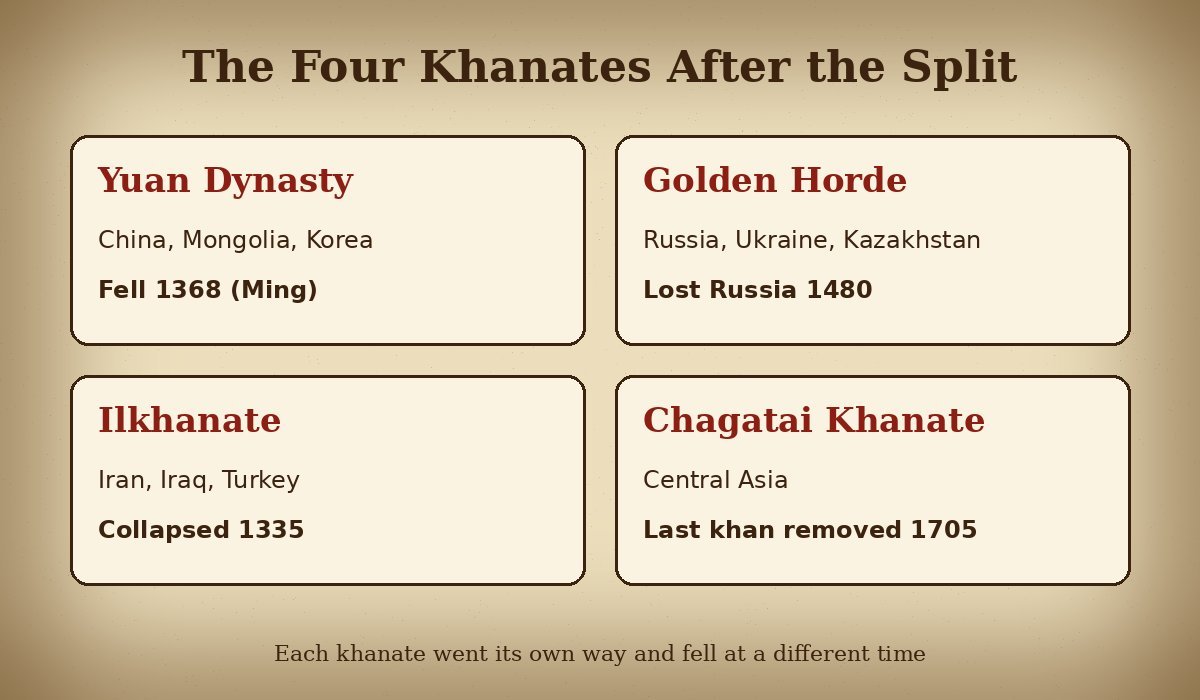
The empire was simply too big for one ruler, and the Mongols had no fixed rule for choosing the next Great Khan. When Möngke Khan died in 1259, his brothers Kublai and Ariq Böke fought a civil war over the throne. Kublai won, but by then the empire had split into four separate khanates, each ruled by a different branch of Genghis Khan’s family.
- Yuan Dynasty — China and Mongolia, founded by Kublai Khan. Fell to the Ming dynasty in 1368.
- Golden Horde — Russia, Ukraine and the western steppe. Lost control of Russia in 1480.
- Ilkhanate — Persia (Iran), Iraq and nearby lands. Collapsed in 1335.
- Chagatai Khanate — Central Asia. Its last khan was removed in 1705.
Each khanate followed its own interests, and some even fought each other. Kublai’s attempts to invade Japan in 1274 and 1281 also failed after typhoons destroyed his fleets — storms the Japanese later called kamikaze, or “divine wind.”
What Did the Mongol Empire Leave Behind?
- A connected world: Trade, ideas, foods and technologies such as paper money, gunpowder and printing knowledge moved more freely between East and West.
- Modern borders: Russia, China and Iran were all shaped by Mongol rule and its collapse.
- Religious tolerance: The Mongols generally allowed people of different religions to worship freely.
- A genetic signature: A widely reported 2003 genetic study suggested that about 0.5% of men worldwide — roughly 16 million — may share a Y-chromosome line linked to Genghis Khan’s family.
Big empires often hide small, strange stories. For a very different kind of conflict, read about the war that ended in just 38 minutes. And for the opposite of the Mongol Empire’s size, see the smallest country in the world.
Frequently Asked Questions
Was the Mongol Empire bigger than the British Empire?
No. The British Empire was larger overall at about 35.5 million km² in 1920, but its lands were scattered around the world. The Mongol Empire, at about 24 million km², is the largest connected land empire ever.
Was the Mongol Empire bigger than the Roman Empire?
Yes, by far. At its peak, the Roman Empire covered about 5 million km², so the Mongol Empire was roughly five times larger.
Who ruled the Mongol Empire at its largest?
Kublai Khan, the grandson of Genghis Khan. The empire reached its greatest size around 1279, when his forces completed the conquest of southern China.
How long did the Mongol Empire last?
As a united empire, only about 54 years (1206–1260). Its successor khanates lasted much longer, with the Yuan dynasty ending in 1368 and the last Chagatai khan removed in 1705.
How many people did the Mongol Empire rule?
About 110 million people at its peak, which was roughly a quarter of the world’s population at the time.
What was the capital of the Mongol Empire?
The first capital was Karakorum in Mongolia. Kublai Khan later moved his capital to Khanbaliq (Dadu), which is modern-day Beijing.
The Mongol Empire in 8 Key Facts
- Founded in 1206 by Genghis Khan.
- Peak size around 1279: about 24 million km² (9.3 million square miles).
- Covered roughly 16% of Earth’s land area.
- Ruled about 110 million people — around a quarter of humanity.
- The largest contiguous (connected) empire in history.
- Held together by the Yam relay system and paiza passports.
- Split into four khanates after a civil war that began in 1260.
- The Mongol-led Yuan dynasty fell in China in 1368.
In less than one lifetime, a few nomadic tribes built an empire so large it changed maps, trade and even DNA across the world. That is how big the Mongol Empire really was.