Quick Answer
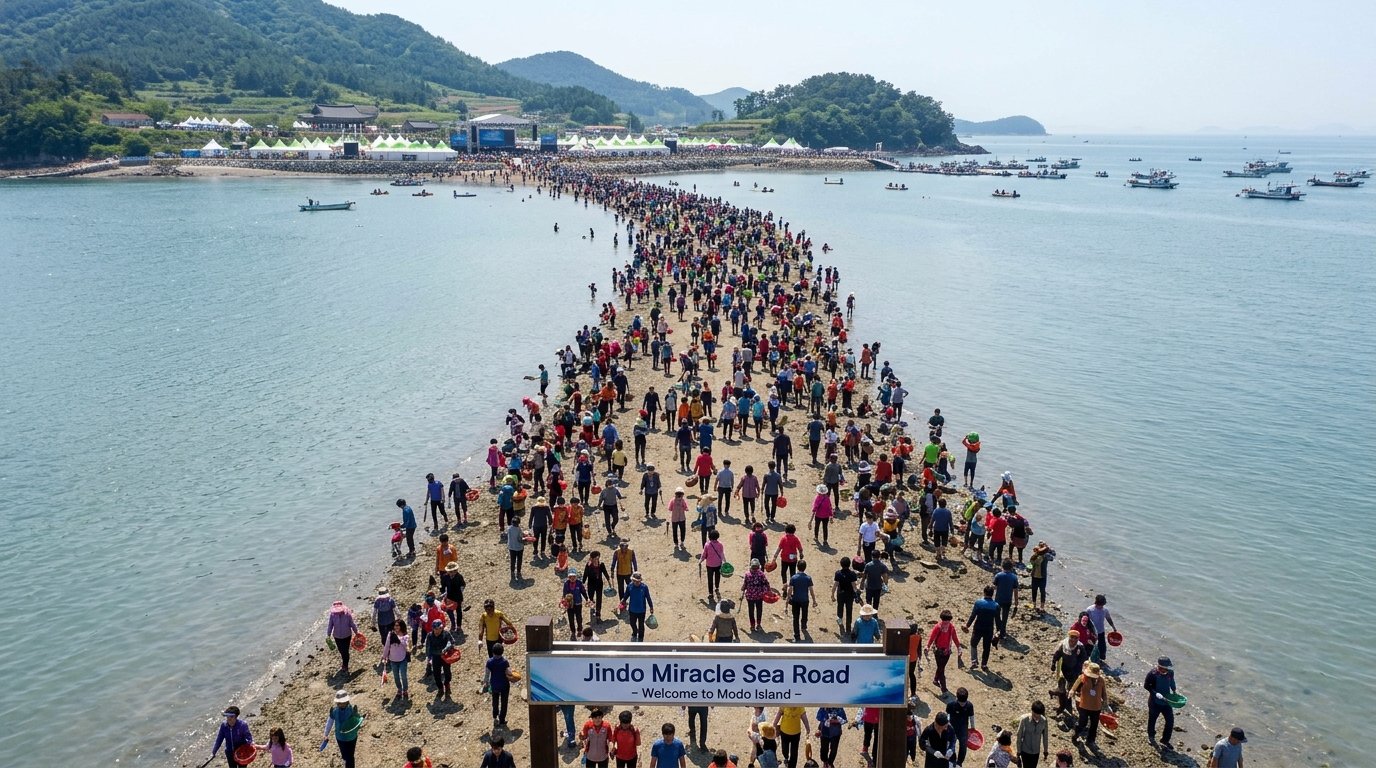
The Jindo sea parting is a natural event in South Korea where the sea drops so low that a hidden sandbar about 2.8 km long and 40 m wide rises above the water. It links Jindo Island to the small island of Modo for roughly one hour. It happens two or three times a year, mostly between March and June, and is caused by extreme low tides, not magic. Locals call it the “Miracle Sea Road,” and many people call it the Korean version of the Moses miracle.
Key Points at a Glance
- Where: Between Hoedong-ri on Jindo Island and Modo Island, South Jeolla Province
- Size of the road: About 2.8 to 2.9 km long and 40 to 60 m wide
- How long it stays open: Around one hour at peak low tide
- When: Two to three times a year, usually March to June
- Cause: Tidal harmonics plus the shape of the local seabed
- Festival: Jindo Miracle Sea Road Festival (2026 edition: April 17 to 20)
Imagine standing on a beach, watching the tide slip away, and then seeing a pale ribbon of sand slowly appear in the middle of the sea. A few minutes later, thousands of people in bright rubber boots are walking across it toward an island on the other side. This is not a movie scene. It is a real event that happens off the southwest coast of South Korea, and it is one of the strangest natural sights in Asia.
In this guide, we explain what the Jindo sea parting is, why it happens, the old legend behind it, and what you should know if you ever want to walk the road yourself.
What Is the Jindo Sea Parting?
Jindo County sits at the southwestern tip of the Korean Peninsula. It is made up of about 250 islands, and the biggest one is Jindo Island itself. Just off its coast lies a much smaller island called Modo.
Most of the year, the two islands are separated by open water. But on a handful of days each spring, the water level falls so far that a long, curved strip of sand and mud comes into view. For about an hour, people can walk from one island to the other on the sea floor, with waves lapping on both sides of them.
Koreans call this path the Sinbiui Badatgil, which means “Mysterious Sea Road.” In English it is often called the Miracle Sea Road or simply the Jindo sea road. There are around 20 smaller sea partings along the Korean coast, but the one at Jindo is the biggest and most famous.
Why Does the Sea Part in Jindo, South Korea?
The sea does not actually split down the middle. What really happens is that the whole sea level drops, and a raised ridge of sand on the seabed is left above the waterline. Two things work together to make this possible.
1. Tidal Harmonics Line Up
Tides are created by the pull of the Moon and the Sun on Earth’s oceans. But that pull is not the only factor. The Earth’s spin, the changing distance between the Earth and the Moon, and the tilt of the Moon’s orbit all add their own small rhythms to the tide. Scientists call these repeating rhythms tidal harmonics.
Most of the time, these rhythms are out of step, so they partly cancel each other out. A few times a year, however, many of them line up together. When that happens, the low tide becomes far lower than normal. Think of it like several waves on a pond meeting at the same point and creating one big dip.
2. The Seabed Has a Hidden Ridge
A very low tide alone would not create a road. The second part of the science behind the Jindo sea parting is the local geography. Over thousands of years, sand and sediment have built up along a calm line of water between Jindo and Modo. This created a natural underwater ridge that sits higher than the seabed around it.
The nearby Myeongnyang Strait also plays a role. It acts like a funnel that controls how much the water rises and falls in this area. As long as the coastline and the strait keep their current shape, the sea road is expected to keep appearing every year.
When Does the Jindo Sea Parting Happen?
The road usually appears two or three times a year, mostly between March and June. Smaller partings can also occur in the autumn, but these often happen late at night, which makes them hard to enjoy.
Because tides follow predictable cycles, local authorities can calculate the exact dates and hours months in advance. The main festival is then scheduled around the lowest tides of the spring season. The 2026 festival, for example, ran from April 17 to 20.
How Long Does the Jindo Sea Road Stay Open?
At its peak, the full path stays visible for about one hour. Visitors generally have a little extra time on either side of that hour, but the tide comes back steadily. Anyone walking the road must watch the clock and follow safety staff, because the water can return faster than people expect.
The Legend of Grandma Bbong
Long before scientists explained tidal harmonics, the people of Jindo had their own story for the sea road. It is known as the legend of Grandma Bbong (also spelled Ppong or Bbyong).
According to the tale, the village that is now Hoedong-ri was once troubled by fierce tigers. The attacks became so frequent that the villagers escaped by boat to Modo Island. In the rush, one elderly woman, Grandma Bbong, was left behind.
Alone and missing her family, she prayed every day to Yongwang, the Dragon King of the Sea. One night, the sea god appeared in her dream and promised that a rainbow road would open across the water. The next day, the sea pulled back, and a path appeared. Her family came across the road to find her, and they were reunited.
Today, a large statue of Grandma Bbong and a tiger stands near the starting point of the sea road. For many locals, the event is still as much about hope and family as it is about tides.
Why Is It Called the Korean Version of the Moses Miracle?
The sea road was a local tradition for centuries, but the wider world barely knew about it until 1975. That year, Pierre Randi, the French ambassador to South Korea, saw the event while visiting Jindo. He later wrote about it in a French newspaper and compared it to the biblical story of Moses parting the Red Sea.
The name stuck. Ever since, the Jindo sea parting has been known around the world as the Korean version of the Moses miracle, and tourist numbers have grown year after year.
Jindo is not the only place where nature creates something that feels unreal. The lake in Tanzania that turns animals into stone is another example of a natural process that looks like a myth until you understand the science.
The Jindo Miracle Sea Road Festival
The parting is celebrated every spring with the Jindo Miracle Sea Road Festival, one of South Korea’s most popular cultural events. Hundreds of thousands of visitors attend, and some estimates put the number close to a million.
The festival usually lasts about four days and includes much more than the walk itself:
- The sea road walk: Crowds cross toward Modo Island once the path opens
- Seafood gathering: Locals and visitors dig for clams, small crabs, octopus and seaweed on the exposed mudflats
- Folk performances: Traditional Jindo songs, drumming and dance
- Shaman rituals: Ceremonies that honor the sea and the legend of Grandma Bbong
- Torch parades: Night and dawn walks lit by torches
- Local food stalls: Grilled shellfish and regional dishes
The festival has also been named a government-backed cultural tourism festival by South Korea’s Ministry of Culture, Sports and Tourism.
Can You Walk Across the Sea in South Korea?
Yes. Walking the road is the main attraction, and it is open to the public. Here are some practical tips if you plan to go:
- Wear long rubber boots. The path is wet, muddy and has shallow pools. Boots are sold or rented near the site.
- Bring a raincoat. Spring weather on the coast can change quickly.
- Arrive early. Crowds are heavy, and the best viewing spots fill fast.
- Check the tide schedule. The opening time changes each day, sometimes early morning and sometimes evening.
- Do not try to reach Modo if time is short. Follow staff instructions and turn back when told.
- Carry a small container. If you want to collect clams or seaweed, bring something to hold them in.
How to Get There
Jindo is in South Jeolla Province, far from Seoul. Most visitors take a train or bus to Mokpo or Gwangju and then a bus to Jindo. During the festival, many tour companies run day trips from Seoul and Busan, which is often the easiest option for first-time visitors.
Is the Jindo Sea Parting Dangerous?
The event is well managed, and safety staff guide the crowd. The main risk is the returning tide. Because the water comes back across a wide, flat area, it can surround people faster than they expect. Visitors who stay close to the main path and leave on time have nothing to worry about.
Some places on Earth are off-limits for very different reasons. If you are curious about locations that people truly cannot visit, read why no one is allowed to visit North Sentinel Island.
Why the Jindo Sea Road Still Amazes People
Even when you know the science, watching the sea step aside is a powerful experience. It shows how the Moon, the Sun, the shape of a coastline and thousands of years of drifting sand can come together to create something that looks like a miracle.
Like the Gates of Hell crater that has burned since 1971, the Jindo sea road is a reminder that real-world facts are often stranger than fiction.
Frequently Asked Questions
Where is the Jindo sea parting?
It takes place between Hoedong-ri village on Jindo Island and Modo Island, in Jindo County, South Jeolla Province, on the southwest coast of South Korea.
How often does the sea part in Jindo?
The road appears two or three times a year, mainly between March and June, with smaller partings sometimes in autumn.
How long is the Jindo sea road?
The path is about 2.8 to 2.9 kilometers (around 1.8 miles) long and roughly 40 to 60 meters wide.
Is the Jindo sea parting a real miracle?
No. It is a natural event caused by extremely low tides from tidal harmonics, combined with a raised sandbar on the seabed. The legend of Grandma Bbong gives it its “miracle” name.
When is the Jindo Miracle Sea Road Festival?
The festival is held each spring on the dates of the lowest predicted tides. The 2026 festival ran from April 17 to 20. Dates change every year, so check the official Jindo County tourism website before planning a trip.
Can tourists walk to Modo Island?
Yes, visitors can walk along the sea road toward Modo Island while it is exposed, but they must follow safety staff and return before the tide comes back.