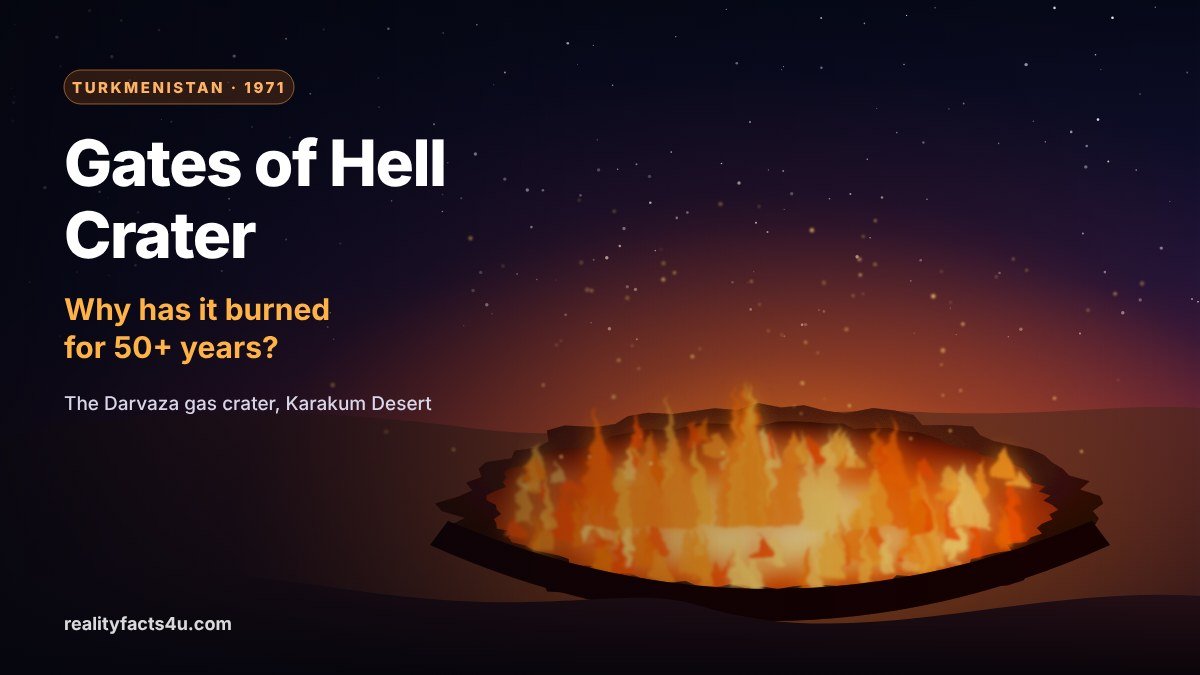
Quick Answer: The Gates of Hell crater, also called the Darvaza gas crater, has been burning since 1971 because it sits on a huge natural gas reserve. Methane keeps leaking up through the ground and feeds the flames. Soviet engineers set it on fire on purpose, expecting the gas to burn off in a few weeks, but they badly underestimated how much gas was underground. In 2025, Turkmenistan said the fire had shrunk to about a third of its former size, but it is still burning.
Key Facts at a Glance
- Location: Karakum Desert, near the village of Darvaza, about 260 km (160 miles) north of Ashgabat, Turkmenistan
- Size: Roughly 60–70 m (200–230 ft) wide and about 30 m (100 ft) deep
- Burning since: 1971, according to the most widely told account
- Fuel: Mainly methane gas seeping from underground reservoirs
- Other names: Door to Hell, Gateway to Hell, Darvaza Crater
- Visitors: More than 10,000 tourists a year
- Latest update: In 2025, officials reported the flames had dropped nearly threefold after new wells were drilled to capture the gas
In the middle of one of the emptiest deserts on Earth there is a giant pit of fire that has not gone out for more than half a century. At night, the Gates of Hell crater glows orange against the black sand of the Karakum Desert, and the heat at its edge is so strong that visitors can feel it on their faces from several meters away. Thousands of fires burn on its walls and floor at the same time. So how did a hole in the ground end up burning for over 50 years, and why has no one been able to put it out? Here is the full story.
What Is the Gates of Hell Crater?
The Darvaza gas crater is a large collapsed hole in the ground in northern Turkmenistan, a country in Central Asia. It takes its name from the small village of Darvaza nearby, whose name is often translated as “gate.” Locals gave the crater the nickname “Gates of Hell” or “Door to Hell” because of how it looks at night: a deep, round pit filled with flickering flames and a constant hissing roar.
The crater sits above the Amu Darya Basin, one of the richest natural gas regions in the world. Turkmenistan holds some of the largest natural gas reserves on the planet, and that underground gas is the reason the fire never runs out of fuel.
How Did the Door to Hell in Turkmenistan Start?
The most famous version of the story goes like this. In 1971, Soviet geologists were drilling in the Karakum Desert while searching for oil and gas. Their rig struck a large underground cavern filled with natural gas. The ground beneath the equipment gave way, and the drilling rig fell into the newly formed crater.
The collapse released large amounts of methane into the air. That was dangerous for two reasons. Methane can poison people and animals nearby, and it can explode. To stop the gas from spreading, the engineers decided to set it on fire. Their plan was simple: the gas would burn off in a few days or weeks and then the fire would die out by itself.
It didn’t. The fire has kept burning ever since.
The Origin Story Is Not Fully Confirmed
Here is something many articles leave out. There are no public Soviet records that clearly prove the 1971 story. Some Turkmen geologists say the crater actually collapsed in the 1960s and was only set on fire in the 1980s. Records from that time are missing, classified or hard to access, so nobody can say for certain exactly when it started burning. What everyone agrees on is that a Soviet-era gas drilling operation caused the collapse, and that the fire was lit on purpose.
Why Is the Darvaza Gas Crater Still Burning?
The simple answer is that the fuel never ran out. The Soviet engineers thought they had hit a small, isolated pocket of gas. In reality, the crater is connected to a much larger gas system deep underground. Natural gas keeps rising through cracks in the rock and soil, and as soon as it reaches the surface it meets the flames and ignites.
Three things keep the Gates of Hell burning:
- A steady gas supply: Methane keeps leaking up from the reservoirs below, giving the fire a continuous source of fuel.
- Plenty of oxygen: The crater is open to the air, so the fire always has the oxygen it needs.
- Thousands of small vents: The fire is not one big flame. It is made of countless small fires along cracks in the walls and floor. If one goes out, the others relight it.
Temperatures inside the crater are often reported at around 1,000°C (over 1,800°F). That is hot enough to melt aluminum.
Why Hasn’t Anyone Put the Fire Out?
Putting out a fire like this is far harder than it sounds. You can’t simply pour water on it, because the gas would keep leaking and could build up into a dangerous cloud that might explode when it relights. Filling the crater with sand or concrete is also risky, because the gas could escape somewhere else and create new leaks in the desert.
The real solution is to stop the gas before it reaches the crater. That means drilling wells nearby to capture the methane underground, which costs a lot of money and needs careful engineering. For decades, nobody tried. The crater was remote, and in later years it became a tourist attraction that brought visitors to the country.
Will Turkmenistan Put Out the Gates of Hell Fire?
Turkmenistan’s leaders have talked about closing the crater more than once:
- 2010: President Gurbanguly Berdimuhamedow ordered experts to find ways to reduce the crater’s effect on gas development in the area.
- January 2022: He announced a plan to put out the fire for good, saying it harmed the environment, people’s health and the country’s gas industry. A government commission was formed to find a method.
- June 2025: At an energy conference in Ashgabat, Irina Luryeva, director of the state gas company Turkmengaz, said the fires had been reduced “nearly threefold.” Engineers had drilled several wells around the crater to capture the methane before it could reach the flames.
Visitors say the glow that could once be seen from far across the desert is now much weaker. Large parts of the crater wall are dark, and only some pockets of fire remain. The Gates of Hell is not closed yet, but for the first time in more than 50 years it is slowly dying down.
Why Closing It Matters for the Planet
Methane is a powerful greenhouse gas. Over 20 years, it traps around 80 times more heat than carbon dioxide. Burning methane turns it into carbon dioxide, which is less harmful, but the crater still releases unburned methane into the air. Satellite data has shown large methane emissions from the area. Capturing the gas reduces pollution and lets Turkmenistan sell the gas instead of wasting it.
Has Anyone Ever Gone Inside the Crater?
Yes, one person has. In November 2013, Canadian explorer George Kourounis became the first person known to reach the bottom of the Darvaza crater. Wearing a heat-resistant suit and a breathing apparatus, he was lowered down on ropes to collect soil samples for the Extreme Microbiome Project, a scientific project that studies life in extreme places. The expedition was supported by National Geographic. Scientists wanted to know whether any microbes could survive in such heat, which may help us understand where life could exist on other planets.
Can You Visit the Gates of Hell in Turkmenistan?
Yes, but it takes planning. Turkmenistan is one of the hardest countries in the world to visit, and almost all foreign travelers need a visa backed by a letter of invitation from a registered tour company. Most people visit the crater on an organized tour.
- Getting there: The crater is about a 4-hour drive north of Ashgabat. The last part is an off-road drive across sand dunes, so a 4×4 vehicle and an experienced driver are needed.
- Best time to see it: After sunset, when the flames glow brightest against the dark desert. Spring and autumn have the most comfortable temperatures.
- Where to stay: Many tours include a night of camping or a stay in a traditional yurt near the crater.
- Safety: A low fence now surrounds the rim, but the edge is made of loose, crumbly clay. Stay back from the edge, especially on windy nights when the heat blows sideways.
The Karakum Desert has other strange places too, including a water-filled crater and a bubbling mud crater nearby, both left over from Soviet-era gas exploration.
Similar Natural Wonders That Seem Impossible
The Gates of Hell is not the only place where nature seems to break the rules. Lake Natron in Tanzania can leave animals looking like they’ve turned to stone. Learn more in our article on the lake that turns animals into stone. If you’re interested in how much of the Earth’s story is written in rock, read about the oldest rock in the world. And for another place with unusual rules, find out why you can’t die in Longyearbyen.
Frequently Asked Questions
How long has the Gates of Hell been burning?
The Gates of Hell crater has been burning since 1971, according to the most common account. That means it has been burning for about 55 years. Some geologists believe the fire may have been lit later, in the 1980s.
Is the Gates of Hell crater still burning in 2026?
Yes, but much less than before. In 2025, Turkmengaz said the flames had been reduced nearly threefold after wells were drilled to capture the gas. Some fires remain, but the crater is far dimmer than it used to be.
What gas is burning in the Darvaza crater?
The fire is fueled mainly by methane, the main component of natural gas. It leaks up from large gas reservoirs beneath the Karakum Desert.
How hot is the Gates of Hell crater?
Temperatures inside the crater are often reported at around 1,000°C (more than 1,800°F). The heat can be felt clearly from the rim.
Why is it called the Gates of Hell?
Locals named it the Gates of Hell, or Door to Hell, because at night it looks like a glowing pit of fire in the middle of a dark, empty desert, with flames, smoke and the smell of burning gas.
Final Thoughts
The Gates of Hell crater began as a mistake. A Soviet gas drilling site collapsed, and engineers set it on fire believing it would burn out in weeks. More than 50 years later, the Darvaza gas crater is still burning because it sits on top of one of the largest gas reserves in the world. Now that Turkmenistan is capturing the gas with new wells, the fire is finally fading. If you want to see this burning crater in the Karakum Desert, you may not have many years left.



1 comment