Lake Hillier, Middle Island, is pink because its water is extremely salty, and only salt-loving microorganisms can live in it. Tiny algae called Dunaliella salina and bacteria such as Salinibacter ruber produce red and orange pigments to protect themselves, and together these pigments turn the whole lake bubblegum pink. Since heavy rains in 2022 diluted the salt, the colour has faded, but scientists expect it can return as the water becomes salty again.
Imagine flying over a quiet island off the coast of Australia. Below you, there’s a thick green forest, a strip of white sand, and the deep blue ocean. Then, right in the middle, sits a lake the colour of strawberry milkshake. No filter, no editing, no trick of the light. Fill a glass with that water and it stays pink in your hand. This is Australia’s Lake Hillier, and for more than 200 years, people have asked the same question: how can a lake be this colour? The answer is stranger than paint and smaller than you can see.
Lake Hillier at a Glance
- Location: Lake Hillier, Middle Island, Western Australia, in the Recherche Archipelago
- Size: About 600 metres long and 250 metres wide
- Discovered: 1802 by British navigator Matthew Flinders
- Why it is pink: Pigment-producing algae, bacteria and archaea living in very salty water
- Still pink today? Not reliably. Its colour faded after record rainfall in 2022
- Can you visit? Mostly by scenic flight or boat tour, as the island is a protected nature reserve
Lake Hillier, Middle Island: Where Is It?
If you are looking it up on a map, search for Lake Hillier, Western Australia, Australia. The lake sits on the edge of Middle Island, the largest of more than 100 islands that make up the Recherche Archipelago near the town of Esperance. The island has no residents, no roads and no hotels. It is part of a protected nature reserve, which is one reason the lake still looks so untouched.
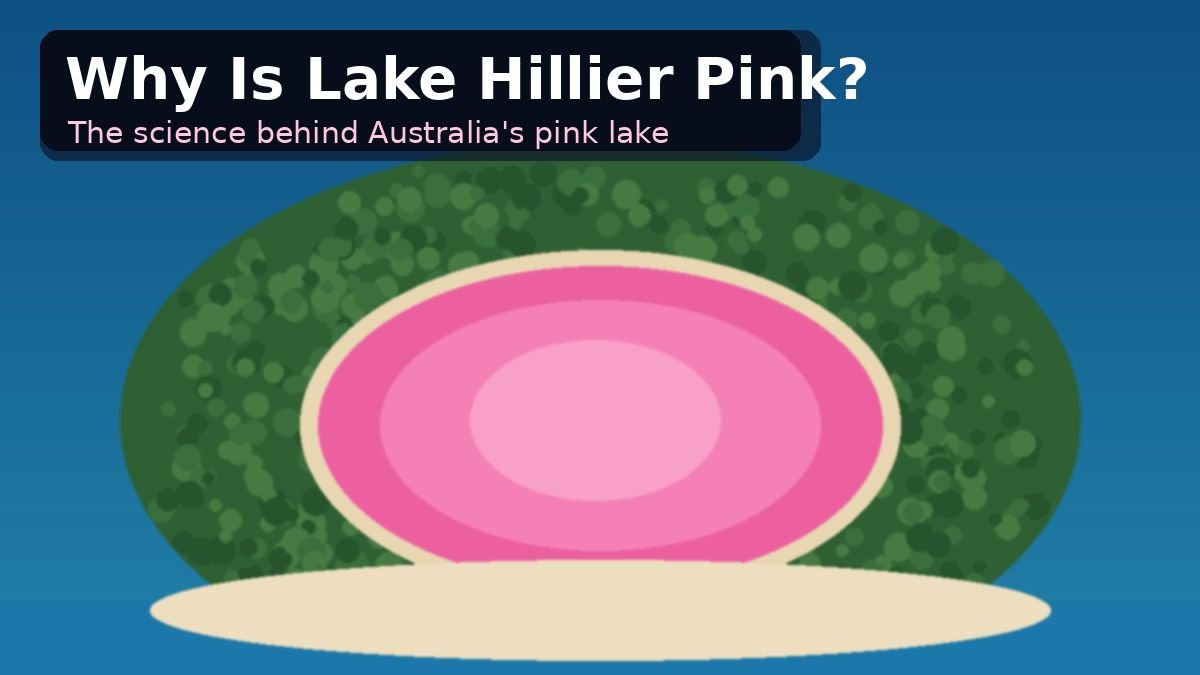
From the air, Lake Hillier Middle Island Western Australia is an unforgettable sight. A pink oval of water sits inside a ring of white sand and dark green eucalyptus and paperbark forest. Only a thin strip of sand dunes separates it from the deep blue Southern Ocean.
Why Australia’s Lake Hillier Became World Famous
Pink lakes exist in many countries, so why did this one go viral? Australia’s Lake Hillier stood out for three reasons:
- The contrast: Pink water, green forest and blue ocean all appear in a single frame, which made it a favourite for photographers and social media.
- The steady colour: For many years, it stayed pink in every season, while most pink lakes changed with the weather.
- The mystery: Scientists could not fully explain the colour until DNA testing in 2015, which kept people curious.
Why Is Lake Hillier Pink? The Science Explained
For many years, the pink colour of Lake Hillier, Middle Island, was called a mystery. Today, scientists have a much clearer answer, and it comes down to three things working together.
1. The Water Is Extremely Salty
Lake Hillier is a hypersaline lake, which means it holds far more salt than normal seawater. Estimates suggest it can be around eight to ten times saltier than the ocean, similar to the Dead Sea. Very few living things can survive in water this salty, so the lake becomes home to a small group of specialists.
2. Salt-Loving Microbes Take Over
The organisms that thrive in such conditions are called halophiles, which simply means “salt lovers”. The best-known one is a microalga called Dunaliella salina. To survive harsh sunlight and high salt, it produces large amounts of carotenoids, the same family of pigments that gives carrots their orange colour.
Simple example: Think of the pigment like sunscreen. When you go out in strong sun, you put on sunscreen to protect your skin. Dunaliella salina does the same thing. Strong sunlight and high salt stress the algae, so it makes thick layers of red-orange pigment to shield itself. Billions of these tiny “sunscreen-wearing” cells together turn the water pink.
3. Pink Bacteria Play a Bigger Role Than Expected
For decades, people believed the algae alone painted the lake pink. Then in 2015, researchers from the Extreme Microbiome Project took water samples and studied the DNA inside them. They discovered that a red-pigmented bacterium called Salinibacter ruber made up a large share of the life in the lake. They also found around ten types of salt-loving bacteria and archaea, almost all carrying pink, red or orange pigments.
So the real answer is teamwork. Algae, bacteria and archaea each add their own shade, and together they create the strawberry-milkshake colour that made the lake famous.
Is the Pink Colour Real or an Illusion?
The colour is completely real. Unlike some lakes that only look pink from certain angles or at sunset, Lake Hillier’s water kept its rosy tint even when scooped into a clear glass. That was one of the details that made the lake so surprising to visitors and scientists. Up close, the shade looks softer and more see-through, but it is still clearly pink.
Is Lake Hillier Still Pink in 2026?
This is the question most travel blogs skip. The honest answer is no, not like the famous photos.
In 2022, Western Australia saw unusually heavy rainfall. Huge amounts of fresh water poured into the lake and diluted its salt. When the water became less salty, the microbes no longer needed their protective pigments in the same way, and other life could move in. Within weeks, much of the bright pink faded to a duller shade.
Simple example: Imagine a glass of strong pink juice. If you pour a jug of plain water into it, the juice is still there, but the colour turns pale. That is what the 2022 rain did to Lake Hillier. The pink microbes did not vanish overnight. The lake simply became too diluted, and with less salt, the microbes made less pigment.
Western Australia’s official tourism information now says the lake is no longer the bubblegum pink it used to be, and that its colour cannot be guaranteed. The good news is that scientists believe the change is temporary. As the water slowly evaporates and the salt builds up again, the pink-producing microbes may bounce back.
Can You Swim in Lake Hillier?
The water itself is not dangerous. It is high in salt but not toxic, and because it is so salty, you would float easily, much like in the Dead Sea. The real problem is access. Middle Island is a protected reserve, and regular tours usually do not land near the lake. In practice, almost nobody gets to swim in it.
How to See Lake Hillier, Middle Island, Western Australia
Because no roads lead there, most visitors see the lake from above. The main options are:
- Scenic flights: Small planes and helicopters fly from Esperance over the Recherche Archipelago. This is the most popular way to see the lake.
- Boat cruises: Some operators run day trips to Middle Island, but landing near the lake is not guaranteed.
- Best timing: Clear, sunny days give the best view. Between roughly July and October, flights can also spot migrating whales along the coast.
Since the colour changed in 2022, it is wise to check recent photos or ask tour operators about the current shade before booking.
The History Behind the Name
British navigator Matthew Flinders first spotted the lake in 1802 after climbing the highest peak on Middle Island, now called Flinders Peak. He returned the following year and collected salt from the lake for his ship. During that visit, a crew member named William Hillier died of dysentery, and the lake was named in his memory.
Later in the 1800s, Middle Island became a base for seal hunters and whalers. In 1889, a man named Edward Andrews moved to the island with his sons to mine salt from the lake. The business did not last, and they left after about a year. Since then, the lake has been left largely to nature.
Lake Hillier vs Pink Lake in Esperance
Many people mix up two different lakes:
- Lake Hillier is on remote Middle Island and can mainly be seen from the air.
- Pink Lake (Lake Spencer) is on the mainland near Esperance and can be reached by road.
Esperance’s Pink Lake lost its pink colour years before Lake Hillier did. Changes in water flow and years of salt harvesting reduced its salinity, and it has looked blue or green for well over a decade.
Other Pink Lakes Around the World
Lake Hillier is the most famous, but it is not alone. Australia has more than ten pink lakes, including Hutt Lagoon in Western Australia, which is easier to visit by car. Outside Australia, Lake Retba in Senegal was long known for its pink water and salt harvesting, though floods in 2022 changed its colour too. Every pink lake follows the same basic rule: high salt plus pigment-making microbes equals pink water.
If you enjoy strange-coloured water, read about why Blood Falls in Antarctica is red and the lake that turns animals into stone. For another ocean wonder, see the sea that splits into a road in South Korea.
Frequently Asked Questions
Why is Lake Hillier pink?
Lake Hillier is pink because salt-loving algae and bacteria living in its very salty water produce red and orange pigments. The main organisms are Dunaliella salina and Salinibacter ruber.
Is Lake Hillier still pink?
Not reliably. Heavy rainfall in 2022 diluted its salt, and the bright pink faded. Scientists expect the colour may return as the lake becomes saltier again.
Can you swim in Lake Hillier?
The water is safe, and you would float because of the salt. However, the island is a protected reserve, so swimming there is almost never possible for regular visitors.
Where is Lake Hillier Middle Island located?
Lake Hillier Middle Island is in the Recherche Archipelago, off the south coast of Western Australia, near the town of Esperance.
What makes Australia’s Lake Hillier different from other pink lakes?
Australia’s Lake Hillier was famous for staying pink all year, even in a glass, and for its striking setting between green forest and blue ocean. Most other pink lakes change colour often with the seasons.
How big is Lake Hillier?
It is a small lake, about 600 metres long and 250 metres wide, covering roughly 0.15 square kilometres.
Who discovered Lake Hillier?
British explorer Matthew Flinders recorded it in 1802. It was named after William Hillier, a member of his crew who died on the island in 1803.
Final Thoughts
So, why is Lake Hillier pink? It is a living colour, made by tiny salt-loving microbes that turn sunlight and salt into pigment. That also explains why it can change. When rain dilutes the salt, the pink fades, and when the salt returns, the colour can come back. Lake Hillier, Middle Island, Western Australia, is a reminder that some of nature’s most beautiful sights are not permanent, and that is exactly what makes them worth understanding.