No one knows for certain what happened to the Lost Colony of Roanoke. About 115 English settlers left on Roanoke Island in 1587 had vanished by 1590, leaving only the word “CROATOAN” carved on a post. The strongest evidence today suggests they did not die in one disaster but moved away, most likely joining the Croatoan people on Hatteras Island, with some possibly moving inland.
Imagine sailing home for supplies, promising your family you will be back within months, and then being trapped on the other side of the ocean for three years. When you finally return, the houses are gone, the people are gone, and the only message waiting for you is a single word carved into a wooden post. That is exactly what happened to John White in August 1590 — and it created America’s oldest unsolved mystery.
In this article
- What Was the Roanoke Colony?
- Why Did John White Leave the Colonists Behind?
- What Did John White Find in 1590?
- What Does “CROATOAN” Mean?
- What Are the Main Theories?
- What Does the Newest Evidence Show?
- What Happened to Virginia Dare?
- Why Is It Still Called a Mystery?
- Frequently Asked Questions
- The Roanoke Mystery in 7 Key Facts
The question of what happened to the Lost Colony of Roanoke has puzzled historians, archaeologists and curious readers for more than 400 years. In this guide, we explain the real timeline, the meaning of the famous “CROATOAN” clue, every major theory, and the latest archaeological discoveries from 2025 — so you can decide for yourself how “lost” the colony really was.
What Was the Roanoke Colony?
Roanoke was England’s first serious attempt to build a settlement in North America, organized by Sir Walter Raleigh. It sat on Roanoke Island, in what is now North Carolina, more than 20 years before Jamestown (1607).
There were actually two Roanoke attempts:
- 1585–1586: A military-style group of about 100 men under Ralph Lane. Short on food and in conflict with local tribes, they gave up and sailed home in 1586.
- 1587: A second group of about 115 men, women and children, led by artist and mapmaker John White as governor. This is the group that became the “Lost Colony.”
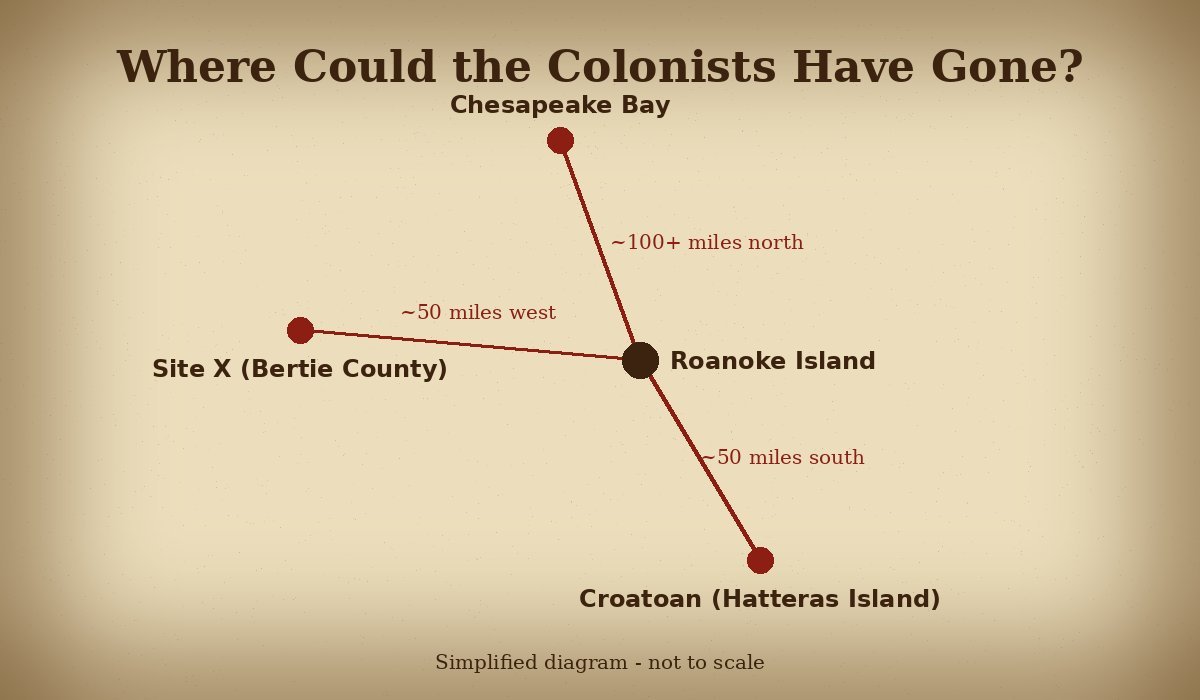
The 1587 settlers were meant to go to the Chesapeake Bay, further north, but the ship’s pilot refused to take them beyond Roanoke. According to the National Park Service, they arrived off Roanoke Island on July 22, 1587.
Why Did John White Leave the Colonists Behind?
Within weeks, the colony was in trouble. Supplies were low, and relations with some local tribes had turned violent. The colonists begged White to sail back to England to bring help and more supplies. He left in late August 1587 — just days after his granddaughter, Virginia Dare, became the first English child born in the Americas.
Before leaving, White and the settlers made an important agreement:
- If they moved, they would carve the name of their new location on a tree or post.
- If they left because they were in danger, they would carve a cross above the name as a distress signal.
White expected to return in a few months. Instead, history got in the way. England was at war with Spain, and in 1588 every available ship was ordered to defend the country against the Spanish Armada. White did attempt a small voyage in 1588, but his ships were attacked and robbed at sea, and he had to turn back. It took him three full years to get back.
The colony was not lost because the settlers vanished. It was lost because no one could reach them for three years.
What Did John White Find in 1590?
On August 18, 1590 — Virginia Dare’s third birthday — White finally landed on Roanoke Island. What he found has fascinated people ever since:
- The houses had been taken down, not burned or destroyed.
- A wooden palisade (defensive fence) had been built around the site while he was away.
- The letters “CRO” were carved into a tree.
- The full word “CROATOAN” was carved into a post of the palisade.
- There was no cross — the agreed sign of danger.
- There were no bodies and no signs of a battle.
His own chests, which had been buried, had been dug up and their contents left to rot — including his books, maps and rusted armor. The National Park Service notes that White found no signs of a struggle or of the colonists leaving in haste.
White was relieved. He believed his family had simply moved to Croatoan, where friendly allies lived. He planned to sail there the next day. But a violent storm damaged the ships, the crew refused to continue, and they sailed back to England. White never saw his family again.
💡 Key insight: The details White recorded — houses carefully dismantled, a clear destination carved in place, and no distress cross — all point to a planned move, not a sudden massacre or disappearance.
What Does “CROATOAN” Mean?
This is the heart of the mystery, but the answer is less mysterious than many people think. Croatoan was the name of two things at once:
- A place: an island about 50 miles south of Roanoke, part of what is now Hatteras Island on North Carolina’s Outer Banks.
- A people: the Croatoan tribe who lived there. One of their members, Manteo, had traveled to England, learned English, and was a close ally of the colonists.
So when the settlers carved “CROATOAN,” they were most likely following the plan exactly: telling White, in plain words, where they had gone. In other words, the famous “cryptic message” may not be cryptic at all — it may be an address.
What Are the Main Theories?
1. Did the colonists join the Croatoan on Hatteras Island?
This is the most widely supported theory. It matches the carved word, White’s own belief, and the Croatoan’s friendship with Manteo. Over the years, archaeologists on Hatteras Island have found 16th-century European items such as gun parts, a sword hilt, pieces of a writing slate and English-made objects mixed with Native artifacts. Later English visitors in the early 1700s also reported meeting Native people on Hatteras who said some of their ancestors were white and could “talk in a book” (read).
2. Did some colonists move inland to “Site X”?
In 2012, researchers studying one of John White’s maps at the British Museum noticed a small paper patch. Under it was a hidden symbol of a fort, marked about 50 miles west of Roanoke, at the head of the Albemarle Sound. Archaeologists from the First Colony Foundation began digging there, in today’s Bertie County, and called it “Site X.” They found English pottery that may date to the colony period, and later more pottery at a nearby location called “Site Y.” The foundation itself says Site X probably held only a small group, not the whole colony.
3. Did they try to reach the Chesapeake Bay?
The Chesapeake was the original destination, so some historians think the settlers went north to it. White never searched there, and no solid archaeological proof has been found.
4. Were they killed by the Powhatan?
Some reports from Jamestown colonists, written about 20 years later, claimed that Chief Powhatan had killed English people living among another tribe. These accounts are secondhand and unclear, and there is no physical evidence to confirm them.
5. Did drought and hunger destroy the colony?
A famous 1998 tree-ring study found that the years around 1587–1589 brought one of the worst droughts the region had seen in roughly 800 years. A drought this severe would have made farming and trading for food extremely hard. Many historians believe it pushed the colonists to leave Roanoke and seek help from Native communities, rather than wiping them out on its own.
6. Were they attacked by the Spanish?
Spain knew about the English settlement and wanted to destroy it. But Spanish records show they were still searching for it years later, and White found no signs of an attack. This theory is now considered unlikely.
What Does the Newest Evidence Show?
In May 2025, archaeologists Mark Horton and Scott Dawson of the Croatoan Archaeological Society announced a new find near Buxton on Hatteras Island: large deposits of hammerscale.
What is hammerscale? It is the tiny flakes of iron that fly off hot metal when a blacksmith hammers it. The Croatoan people did not practice this kind of iron forging, so the researchers argue that hammerscale from the right period points to English blacksmiths — likely the Lost Colonists — working and living on the island.
Dawson believes the colony was never really “lost.” He argues the idea of a vanished colony grew from later storytelling and tourism — including the popular outdoor play The Lost Colony, which first opened in 1937. However, other experts urge caution. As Live Science reported, some archaeologists say the metal could have come from trade or later visitors, and that the find does not settle the question on its own.
Real-world example: This kind of debate is normal in archaeology. A single object can move through trade, so experts look for several kinds of evidence together — artifacts, dates, written records and, ideally, DNA — before calling a case “solved.” That is why Roanoke remains open even though the evidence keeps getting stronger.
Can DNA solve the mystery?
Researchers have tried. The Lost Colony DNA project spent years comparing the DNA of people with family roots in eastern North Carolina against English surnames of the colonists, but it has not found conclusive proof. The best chance would be DNA from 16th-century human remains linked to the colonists — and so far no such remains have been confidently identified.
What Happened to Virginia Dare?
Virginia Dare, born on August 18, 1587, was the first English child born in the Americas. She was a newborn when her grandfather left, and she would have been three years old when he returned to find the colony empty. Her fate is completely unknown. Over the centuries she has become a legend and a symbol of the mystery itself, appearing in poems, stories and place names across North Carolina — but no reliable record of her life after 1587 exists.
Why Is It Still Called a Mystery?
Mysteries like Roanoke grip us because they combine real people, a clear clue and no final answer. On this site we explore other places where history and legend overlap, like why the Gates of Hell crater has burned since 1971 and the village in India where houses have no doors.
For Roanoke, three things keep the mystery alive:
- No single “smoking gun”: every piece of evidence can be explained in more than one way.
- The colonists probably split up: if small groups went to different places, no single site will ever hold “the whole colony.”
- Time: wooden buildings rot, coastlines erode and hurricanes reshape the Outer Banks, so much of the evidence has simply been washed away.
Disease, drought and hunger shaped many colonial stories. To understand how much a single crisis could change history, read our guide on the Black Death and how it changed the world.
Frequently Asked Questions
Was the Lost Colony of Roanoke ever found?
No. No grave, written record or DNA proof has ever confirmed exactly where the colonists went. However, artifacts on Hatteras Island and inland at “Site X” suggest many of them survived and lived among Native communities.
How many people disappeared from Roanoke?
About 115 men, women and children were left on Roanoke Island in 1587, including John White’s daughter Eleanor Dare and his granddaughter Virginia Dare.
What does Croatoan mean?
Croatoan was both the name of an island south of Roanoke (part of today’s Hatteras Island) and the name of the friendly tribe that lived there.
Why didn’t John White go to Croatoan in 1590?
He tried. A storm damaged his ships and the crew refused to continue the search, so they sailed back to England. He never returned to America.
What is the most likely explanation for the Roanoke mystery?
Most historians now believe the colonists moved away in groups and gradually joined Native communities, especially the Croatoan on Hatteras Island, rather than dying in a single event.
Is the Roanoke mystery solved in 2025?
Not completely. The 2025 hammerscale discovery on Hatteras Island strengthens the Croatoan theory, but many experts say more evidence, ideally DNA, is needed before calling it solved.
The Roanoke Mystery in 7 Key Facts
- About 115 English settlers landed on Roanoke Island in July 1587.
- Governor John White left for England in August 1587 to get supplies.
- War with Spain and the Spanish Armada kept him away for three years.
- On August 18, 1590, he found the settlement empty and “CROATOAN” carved on a post.
- There was no distress cross, no bodies and no sign of a battle.
- Croatoan was a friendly tribe and an island about 50 miles south — today’s Hatteras Island.
- Recent finds on Hatteras and at “Site X” suggest the colonists survived and blended into Native communities.
The Lost Colony may never have been truly lost — just separated from the people who were looking for it. Next time you see the word “CROATOAN,” read it the way John White did: not as a curse, but as a forwarding address.